
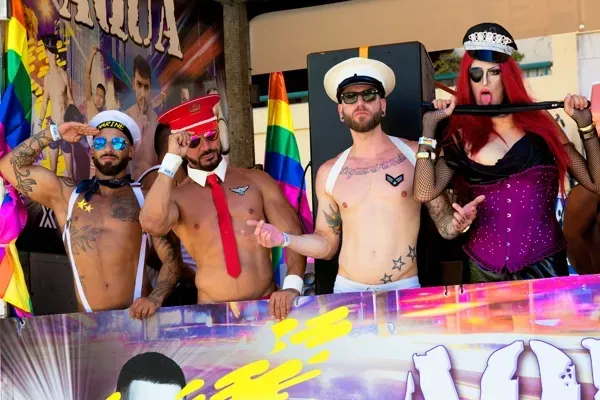
Do labels damage or empower the LGBTQ+ community?
Do labels damage or empower the LGBTQ+ community?
I used to be a portrait photographer. My job was to find one or two things in a person worth highlighting and build the whole image around that — sometimes leaning on a stereotype to keep the message sharp and readable. It's a useful trick when you want people to connect with what they see. The problem is, we do it to each other all the time, with or without camera.
Do labels damage or empower the LGBTQ+ community?
Do labels damage or empower the LGBTQ+ community?
What is the difference between a twink and a twunk?
What labels are used in the LGBTQ and gay community?
Can't we just be .... ourselves?
Should we simply accept stereotypes?
The negative sides of labels on the LGBTQ+ community
It is harder to love yourself.
Do labels in the LGBTQ+ community stop you from finding belonging?
What is the difference between a twink and a twunk?
We often use labels in the LGBTQ+ community because it is easier to "understand" a group of people who fit that label than to know each individual.
Let's face it — you, me, we all do it, and I am not just referring to the gay community.
The world has billions of people and we can't know everybody personally, so instead we generalise, using labels based on stereotypes and our own experiences. There are plenty of labels in the gay community, and they can help you find a tribe you belong to. But those same labels and the stereotypes attached to them can also be the foundation of hatred, homophobia and racism.
What labels are used in the LGBTQ and gay community?
There are many labels and micro tribes in the LGBTQ+ and gay community, and most of them describe somebody’s appearance, scene, lifestyle identity or sexual preferences:
Twinks — young, slim, smooth
Twunks — twinks with muscle
Bears — larger, hairy, masculine
Otters — lean and hairy
Cubs — younger or softer bears
Wolves — rugged, hairy, assertive
Jocks — athletic, sports-oriented
Daddies — older, confident, often dominant
Pups — kink/leather subculture
Scene gays — regularly out on the gay scene
Circuit gays — party circuit regulars
Camp — flamboyant, theatrical
Femme — feminine-presenting
Masc — masculine-presenting
Straight acting — avoids gay cultural markers
Leather/Rubber — fetish and kink community
Tops and bottoms — sexual role preference
Versatile — open to both roles
Queer — broad identity term beyond gay
Non-binary / Genderqueer [relevant to LGBTQ+ scope]
And that's just scratching the surface, our community has dozens more, each with their own sub-tribes and nuances.
We happily use labels in the gay community to attribute specific qualities to people who fall into these categories. And we all seem to be okay with them. In fact, you probably use some of these labels for yourself as well. But is using these labels as innocent as we think?
We think it is pretty normal to reject somebody because of their labels: The famous “No Asians” on Grindr profiles is a notorious example. But also, “I can’t date a bottom because I am a bottom,” or “Sydney gays are self-obsessed.”
Can't we just be .... ourselves?
“You are human. You love who you love. You fuck who you fuck. That should be enough—no labels. No stigmas. Nothing. Just be to be.”
Krista Ritchie – Kiss the Sky
I can tell you that I have heard people say that I come across as standoffish when I go out. One of my friends once said, “You’re like an ice queen” (The Frozen type, not the drug-taking type). At one point, somebody said, and I quote, “You come across as really arrogant and unapproachable, but now that I know you, that is completely the opposite.”
I get it. In crowds, I stand back, and when I first meet people, I need to see what is happening. However, that makes me human, not a stone-cold bitch. (So feel free to come and say something to me, but please give me a chance to defrost ☀️☃️) The point is, we all make judgments based on stereotypes and labels. Often, we are wrong, or we miss out on meeting somebody great.
I am sorry I judged you.
Recently, I came to the realisation of how I judge gay men too. Even though I used to go out a lot (being a party gay), I realised how judgmental I am when meeting people in that environment. I ran into "a party gay" on a few nights out recently, who was "out of it." Later, I saw him in the gym. It was easy to put him in the "party gay box." And I did.
Circuit gays, scene gays and party gays are all humans. In fact, they may be looking for something more than what the party scene has to offer. And often, they are happy to move on when the right person comes along.
But maybe not. Who knows, right? The point is: unless we know the person, the label tells us nothing. And that is exactly the problem.
Why do we keep using labels?
This is the big question: why do we keep using labels in the gay community? Are there benefits to using labels and stereotypes? The answer to that is yes. Using labels and stereotypes can be an excellent way to simplify the world. It can give us a sense of belonging (I am okay with being labelled as “gay” because it makes me feel part of my community.) The challenge comes when labels are used to dehumanise others and spread hatred.
We were not supporting his [a character in Fawlty Towers] views; we were making fun of them [his views],” he explained. “If they [people at the BBC] can’t see that, if people are too stupid to see that, what can one say?”
John Cleese (after one of his episodes of Fawlty Towers was removed from streaming services
Should we simply accept stereotypes?
I have to say, I have seen gay stereotypes appear on TV, which made me think, “Is this appropriate? Do I want gay people to be portrayed like this?” At times, the response is a definite no, but then I analyse that response with two different questions and look at the context:
“Is the intent to spread hatred or cause division?”
Or
“Is it fun, a comedy based on a stereotype that exists, or is it part of a story?”
If the first question is yes, I condemn it; if it is the second question, I can accept it (even if I would like to see a different view)
The negative sides of labels on the LGBTQ+ community
Labels, stereotypes and judging others will never disappear, even if we ban them from our screens. We use them to simplify the world, and there will always be people who use them to spread hatred and cause friction in the community. But love is also part of our community, as is diversity and acceptance. Stopping people from being funny (even when it makes us uncomfortable) will not make the negative aspects of stereotyping go away.
Of course, I do not deny the negative sides of using stereotypes that are often associated with labels:
The foundation of hatred.
Labels and stereotypes are being used to incite hatred, as we can see over and over again. Homophobia and racism are examples of that. It is easier for people to judge (and hate) others based on stereotypes rather than getting to know individuals and making up their minds.
It is harder to love yourself.
Before coming out, I perceived gay men to be “handbag swirling outlandish and camp.” If you’re offended by that, I’m sorry. But that is how I perceived the gay community. There were no role models except for those stereotypes. It made it much harder to come out and connect with the gay community. Fortunately, things are much better in that respect these days, but stereotypes still exist. I know many gay men who want nothing to do with the gay community because “They flaunt themselves during Mardi Gras, dress up and act in a way that is not me.” Yes, the stereotypes are still there. And being subjected to those stereotypes makes it much harder for people to love and accept themselves.
You miss out
The other part of relying on stereotypes is that you miss out. I caught up with the “party gay.” He is a wonderful human being with whom I managed to have nearly 4 hours of deep and meaningful conversations. And I learned more about the “hot crowd” at parties. (Apparently, it is all an attitude, and under that veneer of coolness and attitude, you can find guys who are just like you and want to stay at home and play Monopoly or watch Netflix with their boyfriend.)
Do labels in the LGBTQ+ community stop you from finding belonging?
One thing is for sure: stereotypes and labels are here to stay. On the positive side, they can make it easier for people to come out, accept themselves, and find their place in the gay community. But they can also lead to misunderstanding and fragmentation.
Labels are good for creating a sense of belonging. But they can also lead you to build a small tribe based on similarity alone, and without realising it, you start to judge other tribes by their stereotypes rather than by the individuals in them. That is how the fragmentation of our community grows.
So do your best to break through the barriers that stereotypes create, and try to get to know the individuals behind them. That is the only way to break down the walls between us, and the only way we can build a gay community that truly loves and supports each other.


